Award-winning custom 3D printing. Shipping to Ireland, UK, Europe, Iceland and USA. See the details
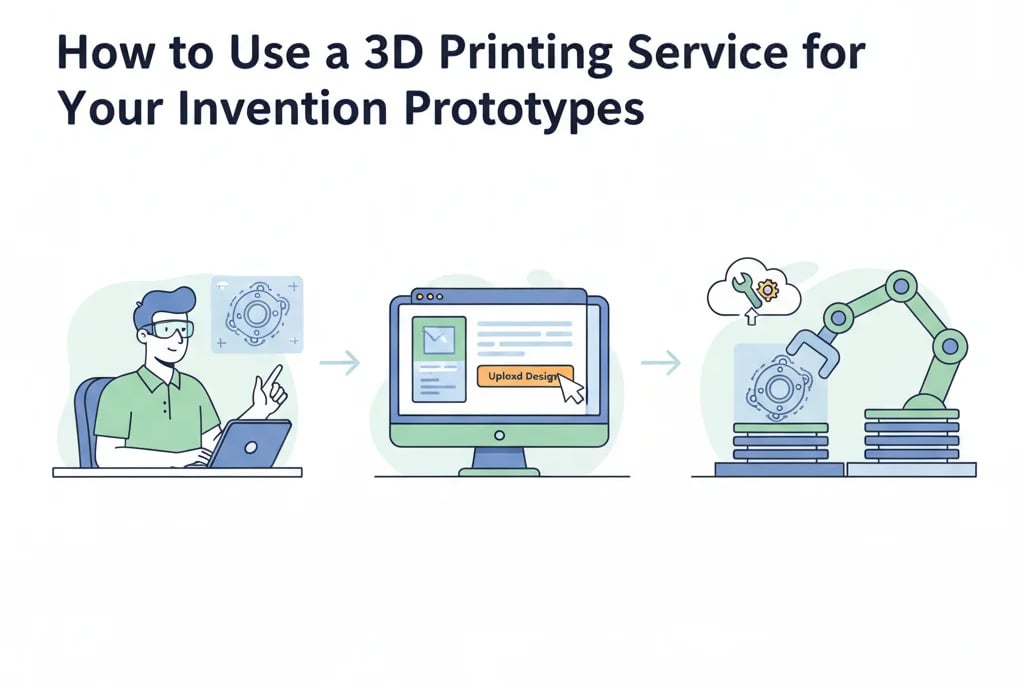
How to Use a 3D Printing Service for Your Invention Prototypes
In the fast-paced world of innovation, bringing a groundbreaking idea from concept to tangible reality can be both exhilarating and challenging. For inventors, entrepreneurs, and product developers across Ireland, the traditional hurdles of manufacturing prototypes—high costs, long lead times, and complex processes—have often stifled creativity. However, with the advent of accessible and professional 3D printing services, these barriers are rapidly diminishing. The ability to quickly and affordably create physical prototypes allows you to test, refine, and present your invention with unprecedented speed and confidence.
This comprehensive guide is specifically designed for visionary individuals like you, offering a clear, step-by-step roadmap on how to effectively utilise a 3d printing service for inventors. We'll demystify the process, from initial concept to holding your first physical prototype, ensuring you understand every crucial decision along the way. You’ll learn how to transform your sketches and digital designs into real-world objects, validate your ideas, and iterate with ease. Whether you're developing a complex mechanical part, a unique consumer product, or a functional custom 3d manufacturing on demand solution, this guide will equip you with the knowledge to navigate the world of 3d print on demand Ireland, ensuring your innovative concepts receive the quality and attention they deserve. We'll cover everything from design best practices and material selection to finding the right 3d printing service for prototypes Ireland, helping you make informed choices that will accelerate your journey from imagination to marketplace. With PrintIn3D, an award-winning local service recognised as a 'Silver Rising Star' at the Irish Print Awards 2026, you're in trusted hands for quality, reliability, and unparalleled customer care.
Who This Is For
Aspiring Inventors & Entrepreneurs: Those with innovative product ideas seeking a cost-effective way to create physical prototypes.
Product Designers & Engineers: Professionals needing rapid iteration and functional testing of new designs.
Makers & Hobbyists: Individuals looking to bring complex personal projects or custom replacement parts 3d printing Ireland to life.
Startups: Companies requiring quick and efficient prototype manufacturing to secure funding or demonstrate concepts.
Anyone without a 3D Printer: Individuals who want to leverage the power of 3D printing without the investment in equipment, maintenance, or expertise.
Step 1: Ideation & Concept Validation – Laying the Groundwork for Your Invention
Every great invention begins with a spark—an idea to solve a problem, improve an existing solution, or create something entirely new. Before diving into the technical aspects of design and printing, it's crucial to thoroughly explore and validate your concept. This initial phase helps ensure you're investing time and resources into an invention that has potential and addresses a real need. It’s about asking the right questions: What problem does my invention solve? Who is it for? How will it work?
Conceptualisation is more than just dreaming; it’s a structured process of defining the scope, features, and potential challenges of your invention. During this stage, rough sketches, brainstorming sessions, and detailed notes are invaluable. They serve as the foundational blueprint from which your 3D model will eventually emerge. Thinking through the mechanics, ergonomics, and aesthetics early on can save significant time and money during later design and prototyping iterations. This is also where you start to consider the core functionalities that your first prototype must demonstrate.
Key Actions:
Define the Problem: Clearly articulate the problem your invention aims to solve. The clearer the problem, the more focused your solution can be.
Brainstorm & Sketch: Begin with rough sketches of your idea from multiple angles. Don't worry about perfection; focus on capturing the core design and functionality. Visualising your idea helps in identifying potential issues early.
Research Existing Solutions: Investigate if similar products or solutions already exist. Understand their strengths and weaknesses. This informs your unique selling proposition and avoids reinventing the wheel.
Identify Your Target User: Who will use your invention? Understanding their needs, preferences, and how they interact with similar products will guide your design decisions.
Outline Core Functionalities: List the essential features and actions your invention must perform. This helps prioritise what your initial 3d printing service for prototypes Ireland needs to demonstrate.
Tip: Document everything! Keep a dedicated notebook or digital file for all your ideas, sketches, research, and insights. This not only helps you track your progress but also provides a record for potential patent applications later.
Step 2: Designing Your Invention for 3D Printing – Mastering the CAD Process
Once your concept is solid, the next critical step is to translate your ideas into a digital 3D model, commonly referred to as CAD (Computer-Aided Design). This digital blueprint is what a 3D printer reads and uses to create your physical object. For inventors, mastering CAD design, or at least understanding its principles, is fundamental to successful prototyping. It allows for precision, iteration, and the ability to visualise your product from every angle before a single gram of material is used.
There's a wide range of CAD software available, catering to different skill levels and project complexities. For beginners, intuitive tools like Tinkercad offer a gentle introduction to 3D modelling. Intermediate users might explore Fusion 360, SolidWorks, or SketchUp, which provide robust features for engineering and industrial design. These programs allow you to create intricate geometries, define precise dimensions, and simulate how different parts fit together. If you're not comfortable with CAD yourself, PrintIn3D also offers 3D design services, helping you transform your sketches into print-ready files. Remember, the quality of your 3D print is directly dependent on the quality and accuracy of your CAD model.
Key Actions:
Choose Appropriate CAD Software:
Beginner-Friendly: Tinkercad (free, web-based, excellent for simple shapes and learning basics).
Intermediate/Professional: Fusion 360 (free for hobbyists/startups, powerful parametric modelling), SolidWorks (industry standard, professional features), Onshape (cloud-based, collaborative).
Sculpting/Organic Shapes: Blender (free, open-source, powerful for artistic models, but steeper learning curve for precise engineering).
Model Your Invention in 3D: Create your digital model, paying close attention to dimensions, clearances between moving parts (if applicable), and how the parts will assemble. Think about wall thickness – too thin, and your print will be fragile; too thick, and it wastes material.
Consider Design for Additive Manufacturing (DfAM): Design specifically with 3D printing in mind. This includes:
Overhangs: Minimise unsupported sections that might require extensive support structures, which can affect surface finish and add to printing costs.
Wall Thickness: Ensure walls are thick enough to be structurally sound (typically >1-2mm depending on material and size).
Tolerances: Account for slight material expansion/shrinkage and printer accuracy by adding appropriate clearances for mating parts (e.g., 0.2-0.5mm for a snug fit).
Part Orientation: Consider how the part will be printed to maximise strength and minimise supports.
Iterate Digitally: Take advantage of CAD software to make quick design changes and test different variations before committing to a physical print.
Tip: Start with simpler versions of your design. For a complex invention, break it down into smaller, manageable components. You can print these components individually as low cost custom 3d prints and then assemble them to test fit and function. This also reduces costs and speeds up iteration.
Step 3: Preparing Your 3D Model File for Printing
Once your 3D model is complete in CAD, it needs to be exported into a format that 3D printers can understand. The most common and widely accepted format is STL (STereoLithography). This file essentially describes the surface geometry of your 3D model using a collection of interconnected triangles, creating a mesh. Other formats like OBJ are also supported but STL remains the industry standard for sending models to custom 3d printing Ireland services.
Proper file preparation is a critical step that ensures your physical print accurately reflects your digital design. Errors in the STL file, such as "non-manifold" edges, inverted normals, or gaps in the mesh, can lead to print failures or inaccuracies. While professional 3d print on demand Ireland services like PrintIn3D often perform preliminary checks, a clean file from your end minimises delays and potential issues. This stage also involves verifying the scale and orientation of your model, ensuring it prints at the intended size and with optimal structural integrity. For a detailed guide on preparing your file, you can refer to PrintIn3D's 3D Print File Preparation Guide.
Key Actions:
Export Your Model to STL/OBJ: In your CAD software, find the "Export" or "Save As" option and select STL (or OBJ). Ensure you choose a fine resolution or high fidelity setting to capture detail without creating excessively large file sizes.
Check for Mesh Errors: Use free tools like Meshmixer, Netfabb Basic, or even built-in tools in your CAD software (e.g., SolidWorks' "Check Entity" or Fusion 360's "Mesh Repair") to identify and repair common STL errors such as:
Non-manifold edges: Where more than two faces share an edge, which is topologically impossible for a solid object.
Inverted normals: Where the "inside" and "outside" of a surface are incorrectly defined.
Gaps or holes: Openings in the mesh that prevent it from being a solid, watertight object.
Self-intersections: Where parts of the mesh overlap or pass through themselves.
A "watertight" mesh is essential for successful 3D printing.
Verify Scale and Units: Double-check that your model is exported in the correct units (millimeters, inches, etc.) and at the intended scale. A common mistake is a model designed in millimeters being imported as inches, resulting in a print 25.4 times larger than expected!
Consider Part Orientation for Printing: While your custom 3d manufacturing on demand service will optimise this, it's good to think about which orientation might yield the best results for strength, surface finish, and minimal support structures.
Warning: Skipping file preparation can lead to unexpected print failures, dimensional inaccuracies, or even a refusal from the 3D printing service to process your file until it's corrected. A clean file saves time and ensures a higher quality print.
Step 4: Choosing the Right Material for Your Prototype
The material you select for your prototype significantly impacts its functionality, durability, and cost. Different 3D printing materials offer a wide range of properties, from rigid and strong to flexible and heat-resistant. For inventors, selecting the appropriate material is a strategic decision that aligns with the purpose of your prototype: Is it for visual presentation, functional testing, stress analysis, or a combination? PrintIn3D offers a variety of high-quality 3D printer filament options to suit diverse needs, ensuring you get the perfect material for your 3d printing service for prototypes Ireland.
Understanding the characteristics of common filaments is key. For initial visual models or basic fit testing, PLA (Polylactic Acid) is often the go-to due to its ease of printing and low cost custom 3d prints. However, if your invention requires higher durability, temperature resistance, or flexibility, you’ll need to explore other options. Services like PrintIn3D provide detailed information on their available materials, and their experts can guide you in making the best choice. For a deeper dive into materials, refer to PrintIn3D's comprehensive 3D Printing Materials Guide.
Key Actions:
Understand Your Prototype's Requirements:
Functional Prototype: Needs to withstand stress, heat, chemicals, or impact?
Visual Model: Primarily for aesthetic presentation? Surface finish and colour might be paramount.
Fit Test: Needs precise dimensions and good dimensional stability.
End-Use Part: Requires properties akin to the final product.
Research Common 3D Printing Materials:
PLA (Polylactic Acid): Biodegradable, easy to print, rigid, good for visual models, conceptual prototypes, and low cost custom 3d prints. Not ideal for high temperatures or outdoor use.
PETG (Polyethylene Terephthalate Glycol): Stronger and more durable than PLA, better temperature and chemical resistance, slightly flexible, good for functional prototypes, and replacement parts 3d printing Ireland.
ABS (Acrylonitrile Butadiene Styrene): Known for strength, impact resistance, and heat resistance. Often used for end-use parts and robust functional prototypes. Requires careful printing conditions.
TPU (Thermoplastic Polyurethane): Flexible and elastic, excellent for parts requiring rubber-like properties, such as gaskets, phone cases, or dampeners. Available in various Shore hardnesses.
Specialty Filaments: Materials like Nylon (high strength, wear resistance), Carbon Fiber infused (stiffer, stronger), or wood/metal composites (aesthetic appeal) for more specific needs.
Consult with PrintIn3D Experts: If you're unsure, reach out to the custom 3d printing Ireland service. Describe your invention's intended use and environmental conditions, and they can recommend the optimal material.
Tip: For your initial 3d printing service for prototypes Ireland, especially when iterating on form and fit, start with low cost custom 3d prints in PLA. Once the design is finalised, then invest in more specialised and expensive materials for functional testing or end-use prototypes.
Step 5: Finding a Reliable 3D Printing Service in Ireland
While owning a 3D printer can be appealing, for inventors, a professional 3d printing service in Ireland offers significant advantages. You gain access to industrial-grade printers, a wider range of materials, expert knowledge, and faster turnaround times without the upfront investment, maintenance, or learning curve. For individuals seeking a 3d printing Dublin or nationwide 3D printing service for makers, choosing the right partner is paramount.
PrintIn3D stands out as an award-winning service, recognised as a 'Silver Rising Star' at the Irish Print Awards 2026. We pride ourselves on providing a hassle-free experience with fast turnaround, friendly WhatsApp support, and a commitment to quality. Our services cater to a diverse range of needs, from fast 3D printing for startup prototypes in Dublin to bespoke custom 3d manufacturing on demand solutions across the country. Our 30-day risk-free return policy, including shipping, underscores our confidence in our work and commitment to your satisfaction. When evaluating services, look beyond just price; consider reputation, support, and the ability to protect your intellectual property.
Key Actions:
Research Local Providers: Look specifically for custom 3d printing Ireland services that specialise in 3d printing service for prototypes Ireland. Check their websites, read customer testimonials, and look for social proof or awards (like PrintIn3D's 'Silver Rising Star' at the Irish Print Awards 2026 – learn more here).
Evaluate Capabilities and Expertise:
Printer Technology: Do they use FDM, SLA, SLS, or other technologies? FDM is common for prototypes, but other methods offer higher detail or different material properties.
Material Range: Do they offer the specific materials your prototype requires?
Post-Processing: Do they offer finishing services (sanding, painting, assembly) if needed?
Expertise: Do they have staff knowledgeable enough to advise you on design for printability or material choices?
Inquire About Turnaround Times and Support: Fast iteration is crucial for inventors. Ask about typical lead times for custom 3d manufacturing on demand and what kind of customer support they offer (e.g., WhatsApp support for quick queries).
Discuss Intellectual Property (IP) Protection: For inventors, protecting your idea is paramount. Ensure the service offers or is willing to sign a Non-Disclosure Agreement (NDA) to safeguard your design. PrintIn3D readily provides NDAs for your peace of mind.
Check Pricing Models: Understand how they quote projects – per gram, per hour, or a flat fee for specific services. Compare their 3D printing pricing structure to ensure it aligns with your budget for low cost custom 3d prints.
Tip: Don't hesitate to contact the service directly with questions. A responsive and helpful team, like PrintIn3D, is a strong indicator of good customer service and reliability. This is especially true for startup prototypes where quick, clear communication is essential.
Step 6: Getting a Quote and Placing Your Order
Once you've chosen your custom 3d printing Ireland service, the next step is to get an accurate quote and formally place your order. This involves providing all the necessary details about your 3D model, desired material, quantity, and any specific requirements. A transparent quoting process allows you to understand the costs involved and ensures that there are no surprises. PrintIn3D's online platform makes this process straightforward, offering clear 3D print estimates, print time, and cost calculations.
During this stage, clear communication with your 3d print on demand Ireland provider is essential. Provide as much detail as possible to ensure your prototype is printed exactly to your specifications. This includes any specific tolerances, surface finish preferences, or critical dimensions. Reviewing the quote carefully before approval is crucial to confirm all aspects align with your expectations for your 3d printing service for prototypes Ireland.
Key Actions:
Upload Your 3D Model File: Submit your prepared STL or OBJ file through the service's online portal. Ensure the file is correct and watertight (as discussed in Step 3).
Select Your Material: Choose the material you've identified as best suited for your prototype's function (e.g., PLA for visual, PETG for functional, TPU for flexible). Be specific about colour if it matters.
Specify Print Settings (if applicable): While many services will optimise settings, you might be asked about infill density (how solid the interior is) or layer height (which affects detail vs. speed). For low cost custom 3d prints, a lower infill might be acceptable for non-structural prototypes.
Indicate Quantity and Urgency: Specify how many units you need and if there's an urgent deadline. Many services offer expedited printing options for a premium.
Provide Additional Instructions: Include any specific notes regarding critical dimensions, areas that need particular attention, or post-processing requirements. If an NDA is in place, reference it here.
Review the Quote: Carefully examine the provided quote, checking the estimated cost, turnaround time, chosen material, and any specified print parameters. Ask questions if anything is unclear regarding your custom 3d manufacturing on demand order.
Confirm Your Order: Once you're satisfied with the quote and terms, proceed with payment and confirm your order.
Warning: Always double-check your uploaded file and selected options before confirming your order. Changes after printing has started can be costly or impossible, leading to delays in your invention's development.
Step 7: Reviewing and Iterating Your Prototypes
Receiving your first 3D printed prototype is an exciting moment, but it's just the beginning of the crucial testing and refinement phase. The power of 3D printing lies in its ability to facilitate rapid iteration, allowing inventors to quickly move through design cycles. Your prototype, whether a visual model or a functional part from a 3d printing service for prototypes Ireland, is a physical embodiment of your digital design, offering invaluable insights that screen-based simulations cannot. This is where you test your hypothesis and see how your invention performs in the real world.
Thoroughly examining your prototype for form, fit, and function will reveal areas for improvement. This might include adjusting dimensions for a better fit, strengthening weak points, improving ergonomics, or refining aesthetics. Don't expect perfection on the first try; embracing the iterative process is key to successful invention development. Each iteration brings you closer to a market-ready product, utilising low cost custom 3d prints to perfect your design efficiently.
Key Actions:
Receive and Inspect Your Prototype: Upon delivery from your custom 3d printing Ireland service, carefully examine the print for any defects, dimensional inaccuracies, or aesthetic issues. Check surface finish, layer lines, and overall quality.
Test Form: Does the prototype look as intended? Are the curves smooth, the edges sharp? Does it feel right in the hand (if applicable)?
Test Fit: If your invention has multiple parts, assemble them. Do they fit together seamlessly? Are there adequate clearances? If it interacts with other objects, test those interactions. This is crucial for replacement parts 3d printing Ireland.
Test Function: Put your prototype through its paces. Does it perform its intended function? Does it break under expected load? Does it operate smoothly? Simulate real-world usage conditions as much as possible.
Gather Feedback: Share your prototype with potential users, mentors, or colleagues. Objective feedback can highlight issues you might have overlooked.
Document Findings: Take detailed notes, photographs, or videos of your tests and observations. Identify specific areas for improvement in your CAD model.
Refine Your CAD Model: Based on your findings, return to your CAD software and make the necessary design adjustments. This could involve tweaking dimensions, modifying geometries, or reinforcing sections.
Order Your Next Iteration: Upload the revised CAD file to your 3d print on demand Ireland service and repeat the printing and testing process. Continue iterating until your prototype meets all your functional and aesthetic requirements.
Tip: Don't be afraid to make radical changes in early iterations. It's much cheaper and faster to alter a digital model or print a new low cost custom 3d print than to retool for traditional manufacturing. The more you iterate, the more refined your final invention will be.
Common Mistakes to Avoid for Inventors Using 3D Printing
Skipping Concept Validation: Diving into CAD and printing without thoroughly validating your idea or understanding the problem it solves. This can lead to wasted resources on an unviable product.
Ignoring Design for Additive Manufacturing (DfAM): Designing a part without considering the limitations and strengths of 3D printing technology. This often results in weak parts, excessive support material, or print failures (e.g., too-thin walls, extreme overhangs).
Poor File Preparation: Submitting a non-watertight or error-ridden STL file. This will cause delays as the service has to repair it or prevent it from printing correctly.
Choosing the Wrong Material: Using a material that doesn't match the functional requirements of the prototype (e.g., PLA for a high-stress, high-temperature environment). This leads to failed tests and inaccurate results.
Underestimating Iteration: Expecting a perfect prototype on the first print. Product development is iterative, and successful inventors embrace multiple cycles of design, print, test, and refine.
Neglecting Intellectual Property: Not securing your invention with an NDA before sharing designs with a 3d printing service for inventors, especially when dealing with novel concepts.
Over-Complicating Initial Prototypes: Trying to incorporate every feature into the very first prototype. Focus on the core functionality and essential aspects first, then add complexity in subsequent iterations.
Not Testing Thoroughly: Receiving a prototype and simply visually inspecting it without rigorous functional and fit testing. This can lead to critical flaws being missed.
Ignoring Feedback: Being too attached to your initial design and dismissing constructive criticism from testers or your custom 3d manufacturing on demand service provider.
Only Considering Price: Opting for the cheapest 3d print on demand Ireland service without considering their quality, turnaround time, customer support, or expertise. A slightly higher investment can save significant time and frustration in the long run.
FAQ
What file formats does PrintIn3D accept for custom 3D printing?
For custom 3D printing, PrintIn3D primarily accepts STL (.stl) and OBJ (.obj) files. These are the most common formats for 3D printing as they define the surface geometry of your model. We recommend ensuring your files are watertight and error-free for the best printing results. If you have other formats, please contact us, and we'll advise on compatibility or conversion options.
How long does it typically take to receive a prototype from PrintIn3D in Ireland?
The turnaround time for receiving a prototype from PrintIn3D depends on the complexity of your model, chosen material, current workload, and selected shipping option. We pride ourselves on fast turnaround, with many orders ready for dispatch within a few business days. For urgent projects, we offer expedited services. When you get a quote on our website, you'll receive an estimated production and delivery time tailored to your specific order.
Can PrintIn3D help if I don't have a 3D model or CAD design?
Absolutely! We understand that not every inventor is proficient in CAD design. PrintIn3D offers 3D design services, where our team can work with your sketches, drawings, or even just a detailed concept to create a print-ready 3D model. Whether you need a simple mechanical part dimensioned or a complex custom 3d manufacturing on demandmodel, we're here to help bring your ideas to life from concept to print.
What if my prototype isn't perfect after the first print?
It's completely normal for a prototype not to be perfect on the first attempt! The entire purpose of 3d printing service for inventors is to enable rapid iteration. We encourage you to thoroughly test your prototype, identify areas for improvement in your design, refine your CAD file, and then order a revised version. This iterative process is how innovations are perfected, and our service is designed to support you through multiple design cycles to achieve your ideal outcome.
Is my intellectual property safe when using PrintIn3D for my invention prototypes?
Protecting your intellectual property is a top priority for us. PrintIn3D operates with the highest level of confidentiality. We are happy to sign Non-Disclosure Agreements (NDAs) to ensure your innovative ideas and designs remain secure and protected. Our professional approach means you can confidently use our custom 3d printing Ireland service knowing your creations are in safe hands.
Next Steps: Bring Your Vision to Life with PrintIn3D
Ready to transform your brilliant invention into a tangible prototype and accelerate your journey to innovation? PrintIn3D is your trusted partner for 3d printing service for inventors in Ireland. Visit our custom 3D printing servicepage today, upload your design, and get an instant quote to start building the future. Experience award-winning quality, fast turnaround, and hassle-free service that has made us a Silver Rising Star at the Irish Print Awards 2026. Let's bring your ideas to life!
One stop shop for all things 3D
Upload your 3D files for hassle-free printing.
Award-winning custom 3D printing, 3D scanning and 3D design in Ireland and Europe, with fast WhatsApp support.
Help and Support
Know about the latest offers
info@printin3d.ie
+353899605778
© 2026. All rights reserved.