Award-winning custom 3D printing. Shipping to Ireland, UK, Europe, Iceland and USA. See the details
Unpacking 3D Printing Costs: A Comprehensive Guide for Your Project in Ireland
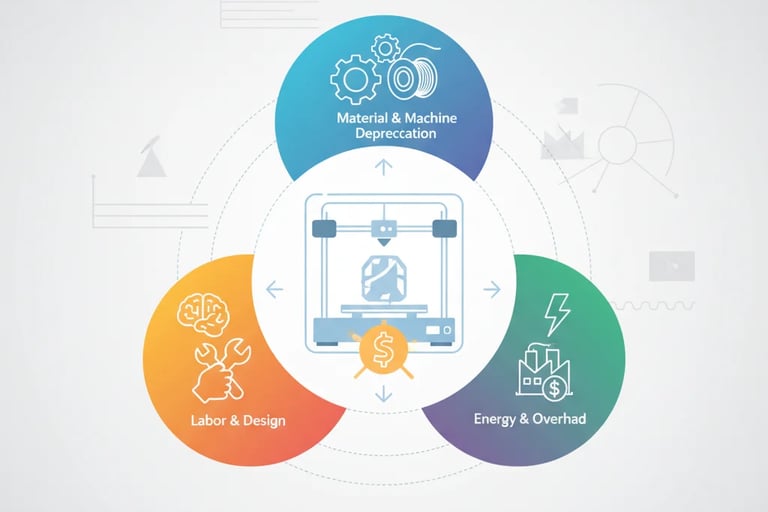
Ever wondered what truly goes into the price of a 3D printed object? Whether you're a seasoned designer, an innovative startup, or someone simply looking to bring a unique idea to life, understanding 3D printing cost is fundamental to budgeting and achieving your vision. It's not just about the plastic – a multitude of factors contribute to the final price, from the intricacies of your design to the choice of materials and post-processing finishes.
At PrintIn3D, we believe in transparency and empowering our customers across Ireland and the EU. This comprehensive guide will walk you through every aspect that influences 3D print pricing, helping you make informed decisions when seeking online custom 3d printing quotes. We'll demystify material choices like PETG 3D printing Ireland, explain how design complexity impacts production, and reveal the hidden costs often overlooked. By the end, you'll be equipped to confidently submit your `STL` or `3MF` files and understand the value behind your custom 3D printed models.
Who This Is For
Individuals and hobbyists wanting to print custom designs without owning a printer.
Startups and businesses needing professional 3D printing prototypes or low-volume production.
Anyone looking to understand how to get the best value for their on demand 3d printing custom orders.
Designers preparing files for external printing services.
Customers interested in 3d printed models buy online for home, office, or tech accessories.
Step 1: Understanding Your Design's Complexity and Geometry
The journey to an accurate 3D printing cost estimate begins with your design. The more complex your model, the more time and material it will require to print, directly impacting the price. Think of it like this: a simple cube is much faster and easier to build than a miniature, intricately detailed sculpture.
Complexity isn't just about fine details; it also relates to the geometry of the object. Models with numerous overhangs, intricate internal structures, or very thin walls often require extensive support material, which adds to both print time and material consumption. Even if the finished part looks simple from the outside, its internal construction can significantly increase costs.
Examine Detail Levels: Highly detailed models with small features or intricate patterns will take longer for the printer to trace and build layer by layer, leading to increased print time and thus cost.
Assess Overhangs and Bridges: Any part of your design that extends outwards without support from below (overhangs) or spans a gap (bridges) will likely need support structures. These supports use extra material and take time to print and remove.
Consider Wall Thickness: Very thin walls can be fragile and prone to failure during printing, sometimes requiring slower print speeds or specific print settings to ensure success, which increases print time. Conversely, overly thick walls might be unnecessarily heavy and use more material than required.
Evaluate Internal Geometry: Solid models use significantly more material than hollowed-out designs. While hollowing can save material, it needs careful consideration to maintain structural integrity and may require drain holes for resin prints.
Tip: Simplify your design where possible without compromising functionality or aesthetics. Removing unnecessary fillets, chamfers, or internal complexities can reduce print time and material usage. If you're unsure about design optimisation, consider utilising 3D design services that can help refine your model for cost-effective printing.
Step 2: Choosing the Right Material for Your Project
The material you select is one of the most significant determinants of 3D printing cost. Different filaments and resins have varying prices, properties, and print requirements. What might be perfect for a decorative piece won't necessarily be suitable for a functional prototype that needs to withstand stress or heat.
Common materials like PLA are generally more affordable and easier to print, making them a good starting point for many projects. However, if your application demands greater strength, flexibility, or heat resistance, you might need to opt for materials like ABS, PETG, Nylon, or even advanced composites. These specialized materials not only cost more per kilogram but can also require specific printer setups, higher temperatures, or enclosed build chambers, further adding to the operational costs.
Research Material Properties: Understand the strengths, weaknesses, and ideal applications for various 3D printing materials. For instance, if you need a strong, durable, and slightly flexible part, PETG 3D printing Ireland is an excellent choice, but it costs more than standard PLA.
Compare Material Costs: Prices for filaments and resins vary widely. Standard PLA is typically the most economical, followed by PETG and ABS. More specialised materials like Nylon, Carbon Fibre-reinforced filaments, or flexible TPU will incur higher costs. Check our 3D printing materials guide for more details.
Consider Material Usage: The total volume of material your print requires is a direct cost factor. Larger objects, or those with solid infill, will naturally consume more material.
Factor in Support Material: Some materials require soluble support structures, which are easier to remove but can be more expensive than standard break-away supports.
Warning: Don't compromise on material quality to save a few euro. Using an unsuitable material can lead to a failed print, a dysfunctional part, or a model that doesn't meet your expectations, ultimately costing you more in reprints and wasted time. Always choose a material that aligns with your part's intended use.
Step 3: Calculating Print Time and Machine Usage
Time is money, and in 3D printing, machine time is a primary driver of cost. The longer a printer is occupied with your project, the more it contributes to the overall expense. This includes not only the actual printing duration but also setup, calibration, and potential post-print cooling times.
Several factors influence print time, including print speed, layer height, and the overall volume of the object. Printing with finer detail (smaller layer height) will yield a smoother finish but significantly increase print time. Conversely, faster print speeds can reduce time but might compromise surface quality or structural integrity. A professional service like PrintIn3D optimises these settings to balance speed, quality, and cost for your online custom 3d printing quotes.
Layer Height: Finer layer heights (e.g., 0.1mm) produce smoother prints but take much longer than coarser layer heights (e.g., 0.2mm or 0.3mm). This choice directly impacts both aesthetic quality and print duration.
Infill Density: The amount of material used to fill the interior of your print. Higher infill percentages (e.g., 80-100%) create stronger, heavier parts but consume more material and increase print time. Lower infill (e.g., 10-20%) is faster and lighter but reduces strength.
Print Speed: While faster speeds save time, they can lead to print defects or reduce precision. Professional services find the optimal balance for each material and design.
Model Size and Orientation: Larger models inherently take longer to print. The orientation of your model on the build plate can also affect print time by influencing the amount of support material needed and the length of tool paths.
Tip: If your project's primary concern is speed and it doesn't require ultra-fine details, discuss options for a coarser layer height with your service provider. This can significantly reduce print time and, consequently, your 3D printing cost. For urgent prototypes, look for services that offer accelerated options, like PrintIn3D's 8-hour custom 3D printing service.
Step 4: Post-Processing Requirements
Once a 3D print finishes on the machine, it often isn't ready for immediate use. Post-processing refers to any steps taken after printing to clean, strengthen, or finish the part. This can range from simple support removal to extensive sanding, painting, or assembly, and each step adds to the overall 3D printing cost.
For many basic prints, support removal might be the only post-processing needed. However, if you require a smooth, blemish-free surface, specific colours, or a higher level of durability, additional labour-intensive steps will be necessary. When getting online custom 3d printing quotes, always be clear about your desired finish.
Support Material Removal: Almost all FDM (Fused Deposition Modeling) prints with overhangs will require support removal. This can be quick for simple supports or painstaking for intricate designs with hard-to-reach areas.
Sanding and Smoothing: To eliminate layer lines and achieve a smooth surface, prints can be sanded. This is a manual, labour-intensive process. Chemical smoothing (e.g., with acetone for ABS) can also be used but requires specific safety protocols.
Painting and Colouring: If your design requires specific colours not available in filament, or a multi-colour finish beyond what a single or multi-material printer can provide, painting adds a significant cost.
Assembly: For multi-part models that need to be put together, assembly time is factored into the total cost.
Curing (for Resin Prints): SLA/DLP/LCD resin prints require a post-curing step under UV light to fully harden and achieve their final mechanical properties.
Warning: Underestimating post-processing needs is a common mistake that can lead to unexpected additions to your 3D printing cost. Discuss your aesthetic and functional requirements clearly with your service provider upfront.
Step 5: Considering Design Services and File Preparation
Not everyone has a ready-to-print `STL` or `3MF` file. If you have an idea but lack the skills or software to create a 3D model, you'll need design services. This is a separate cost from the actual printing but is an essential part of the process for many customers.
Even if you have a file, it might not be perfectly optimised for 3D printing. Issues like non-manifold edges, inverted normals, or incorrect scaling can lead to print failures or suboptimal results. Professional file preparation ensures your model is print-ready, saving time and potential reprints down the line. When you upload STL and print Ireland, PrintIn3D will often perform basic checks, but extensive repairs or optimisations will incur a design service charge.
Conceptual Design: If you're starting from scratch with a sketch or idea, a 3D designer will translate your concept into a printable model using CAD (Computer-Aided Design) software. This is typically an hourly rate service.
Model Optimisation/Repair: Even existing 3D files might need adjustments for printability, such as thickening thin walls, adding necessary tolerances for assembly, or fixing mesh errors. This ensures a successful print and can prevent wasted material and time.
Prototyping Iterations: For professional 3D printing prototypes, you might go through several design iterations to perfect the form, fit, and function. Each iteration, if it requires design changes, will add to the overall cost.
File Conversion: If your design is in an obscure format, it may need conversion to a standard 3D printing format like `STL` or `3MF`.
Tip: Provide as much detail as possible to your designer or 3D printing service at the outset. Clear sketches, reference images, and precise dimensions can significantly reduce design time and associated costs. For more information on file preparation, check out our 3D Print File Preparation Guide.
Step 6: Considering Service Provider Overheads and Expertise
When you seek on demand 3d printing custom orders, you're not just paying for plastic and machine time; you're also paying for the expertise, quality assurance, and operational overheads of the service provider. A reputable service in 3D printing ecommerce Ireland invests in high-quality equipment, skilled technicians, and robust processes, all of which contribute to delivering reliable, high-quality prints.
Factors like machine maintenance, facility costs, software licenses, R&D into new materials, and staff wages are all part of the operational cost that gets factored into your quote. Businesses that offer excellent customer support, fast turnaround times, and a commitment to quality, like PrintIn3D (a Silver Rising Star award winner at the Irish Print Awards 2026), naturally reflect this value in their pricing.
Machine Investment and Maintenance: High-end industrial 3D printers and quality desktop machines require significant capital investment and ongoing maintenance, which are built into pricing.
Skilled Technicians: Experienced operators are crucial for ensuring successful prints, especially with complex geometries or advanced materials. Their expertise in setup, troubleshooting, and post-processing commands a fair wage.
Quality Control: Reputable services perform quality checks throughout the printing process and on finished parts to ensure they meet specified standards. This includes verifying dimensions, surface finish, and structural integrity.
Customer Support: Access to knowledgeable and friendly support (like PrintIn3D's WhatsApp support) adds value, helping you navigate your project from idea to completion.
Research & Development: Staying abreast of the latest technologies, materials, and printing techniques requires ongoing investment in R&D, which ultimately benefits the customer through improved services.
Tip: Don't always choose the cheapest option without considering the provider's reputation and quality. A slightly higher 3D printing cost from a reliable service can save you significant headaches, reprints, and delays in the long run. Look for businesses with transparent pricing models and positive customer testimonials.
Step 7: Shipping and Additional Services
The final element in your total 3D printing cost is often overlooked: shipping. Especially in an 3D printing ecommerce Ireland context, how your finished product gets from the printing facility to your doorstep matters. Additionally, some projects might require specific packaging or express delivery services, which can further influence the price.
Beyond standard shipping, consider any other "add-on" services that might be relevant to your project. These could include rush orders, specific types of packaging for fragile items, or even Non-Disclosure Agreements (NDAs) for sensitive prototypes. Each additional service is designed to enhance your experience or protect your intellectual property but comes with its own cost.
Shipping Location and Method: The distance your print needs to travel (e.g., within Ireland or to the EU) and the speed of delivery (standard vs. express) will directly affect shipping costs.
Packaging Requirements: For delicate or high-value prints, specialized protective packaging might be necessary to prevent damage during transit.
Insurance: If your print is particularly valuable, you might opt for shipping insurance for added peace of mind.
Rush Orders: If you need your print on a tight deadline, many services offer expedited printing and shipping options at a premium. This is common for critical professional 3D printing prototypes.
NDAs: For sensitive intellectual property or confidential projects, requesting an NDA adds a layer of legal protection, which may have an associated administrative fee.
Tip: Plan your project timeline well in advance to avoid rush order fees. Grouping multiple small prints into a single order can also help amortise shipping costs. Always review the shipping options and associated fees before finalising your order. PrintIn3D offers transparent shipping policies across Ireland and the EU.
Common Mistakes to Avoid When Estimating 3D Printing Costs
Navigating the world of 3D printing costs can have its pitfalls. Being aware of these common mistakes can save you time, money, and frustration.
Underestimating Material Costs for Larger Prints: While a small print might use negligible material, scaling up your design can dramatically increase filament or resin consumption, significantly impacting the total 3D printing cost.
Ignoring Post-Processing Needs: Many assume a print is ready straight off the build plate. For a professional finish, sanding, painting, or assembly can add substantial labour time and cost that is often overlooked.
Overlooking Design Flaws: Submitting a faulty or non-optimised design can lead to failed prints, requiring costly reprints or design revisions. Always ensure your `STL` or `3MF` file is print-ready.
Not Considering Print Orientation: The way a model is oriented on the build plate can affect the amount of support material needed, print time, and surface finish. A poor orientation choice can inflate costs.
Choosing the Wrong Material: Selecting a material based solely on price without considering its properties for the intended application can lead to a dysfunctional or fragile part, requiring a costly reprint with the correct material.
Failing to Get Multiple Quotes: While PrintIn3D aims for transparent and fair pricing, it's always good practice to understand market rates, especially for complex projects. However, remember to compare like-for-like services and quality.
Not Clarifying Expectations: Ambiguity regarding desired finish, tolerances, or print quality can lead to dissatisfaction and potential reprints. Clear communication with your service provider is key to getting accurate online custom 3d printing quotes.
FAQ About 3D Printing Cost
Why do different materials have such different 3D printing costs?
Materials vary in price due to their raw component cost, manufacturing complexity, and unique properties. Basic plastics like PLA are abundant and easy to produce. However, specialised materials like carbon fibre-reinforced nylon, flexible TPU, or high-temperature PEEK require more expensive raw ingredients, complex processing, and often have specific performance characteristics (e.g., strength, flexibility, heat resistance) that command a higher price. These differences directly impact the overall 3D printing cost.
Does getting a multi-colour print always increase the cost?
Yes, typically. While some advanced 3D printers can print in multiple colours simultaneously (e.g., using an AMS system for FDM or multi-resin capabilities for PolyJet), this often adds complexity, requires specific setup, and can increase print time due to filament changes or nozzle cleaning cycles. If true multi-colour printing isn't available, manual painting or assembly of pre-coloured parts would be required, both of which are labour-intensive and add to the 3D printing cost.
How can I reduce the cost of my 3D printed model?
You can significantly reduce your 3D printing cost by: 1) Optimising your design to minimise material usage and support structures (e.g., hollowing out models, reducing overhangs). 2) Choosing a more economical material like PLA if its properties meet your needs. 3) Opting for a coarser layer height if fine details aren't critical. 4) Providing a perfectly print-ready file to avoid design or repair fees. 5) Being realistic about post-processing requirements and doing some simple finishing yourself if comfortable.
Is there a difference in cost between FDM and resin 3D printing services?
Yes, there can be a significant difference. FDM (Fused Deposition Modeling) uses spools of plastic filament and is generally more cost-effective for larger, functional parts where surface finish isn't the absolute top priority. Resin (SLA/DLP/LCD) printing uses liquid photopolymer resins and offers much finer detail and smoother surfaces, making it ideal for miniatures, jewellery, and high-detail prototypes. However, resin materials are typically more expensive than filaments, and post-processing (washing, curing) for resin prints adds extra steps, usually leading to a higher overall 3D printing cost per part.
Can I get a quick estimate for my 3D printing project?
Absolutely! Most 3D printing ecommerce Ireland services, including PrintIn3D, offer instant or rapid quote systems. You can simply upload your STL or 3MF file directly to our platform, select your desired material and finish, and receive an instant estimate for 3D printing cost, print time, and material options. This helps you quickly assess the feasibility and cost of your project before committing.
Next Steps: Bring Your Ideas to Life with Confidence
Understanding 3D printing cost empowers you to make smarter decisions for your projects. At PrintIn3D, we're committed to making custom 3D printing accessible, transparent, and hassle-free across Ireland. Ready to get started with your award-winning local service? Upload your design today and receive an instant quote to bring your ideas from concept to reality.
One stop shop for all things 3D
Upload your 3D files for hassle-free printing.
Award-winning custom 3D printing, 3D scanning and 3D design in Ireland and Europe, with fast WhatsApp support.
Help and Support
Know about the latest offers
info@printin3d.ie
+353899605778
© 2026. All rights reserved.