Award-winning custom 3D printing. Shipping to Ireland, UK, Europe, Iceland and USA. See the details
PLA vs PETG for 3D Printing: Your Ultimate Material Guide
PLA vs PETG: Your Ultimate Material Guide for 3D Printing Projects
In the vibrant and ever-evolving world of 3D printing, choosing the right material is often the most important decision you'll make. It can dictate the success, functionality, and aesthetic appeal of your final print. Two materials frequently stand out as top contenders for a vast array of applications, from hobbyist projects to professional 3D printing prototypes: Polylactic Acid (PLA) and Polyethylene Terephthalate Glycol (PETG).
At PrintIn3D, Ireland's award-winning 3D printing service, we understand that navigating the nuances of different filaments can be a bit daunting. Whether you're a seasoned designer looking to optimize a CAD document for small batch 3D printing in Ireland, or a beginner simply trying to get your first successful print, knowing the strengths and weaknesses of PLA vs PETG is crucial. This comprehensive guide is designed to help you make an informed choice, ensuring your next custom 3D print online project with PrintIn3D is an absolute success.
Quick Overview: PLA and PETG
Before we dive into the nitty-gritty, let's get a quick snapshot of our two champions:
Polylactic Acid (PLA)
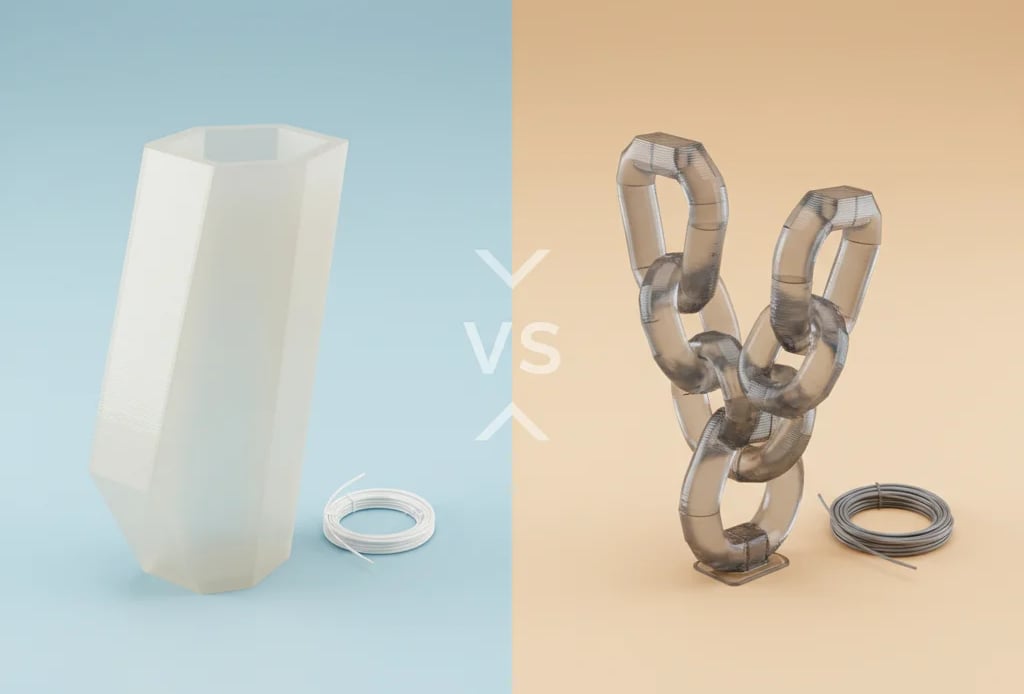
PLA is a biodegradable thermoplastic derived from renewable resources like corn starch or sugarcane. It's renowned for its ease of use, minimal warping, and lack of strong fumes during printing, making it a favourite among beginners and those working in home environments. PLA typically offers good aesthetic qualities with a wide range of colours and finishes, from matte to glossy, and is perfect for decorative items, prototypes where extreme strength isn't required, and models.
Polyethylene Terephthalate Glycol (PETG)
PETG is a more recent addition to the mainstream 3D printing filament market, offering a compelling blend of strength, durability, and flexibility. It combines the ease of printing of PLA with the enhanced mechanical properties of more industrial filaments like ABS. PETG is known for its excellent layer adhesion, impact resistance, and chemical resistance, making it suitable for functional parts, mechanical components, and items that require more robustness than PLA can offer. It's often considered a versatile 'middle-ground' material.
Pros & Cons of PLA
Understanding the advantages and disadvantages of PLA can help you determine if it's the right choice for your project.
Pros of PLA
User-Friendly: PLA is incredibly easy to print, requiring lower extruder and bed temperatures, and producing minimal warping. This makes it perfect for beginners or for those who want a hassle-free printing experience.
Aesthetic Appeal: It consistently produces high-quality prints with smooth surfaces and excellent detail, making it ideal for models, figurines, and decorative items.
Environmentally Conscious: As a biodegradable plastic derived from renewable resources, PLA is a more sustainable option, which is an important consideration for eco-aware projects.
Low Odour: During printing, PLA emits a slightly sweet, non-toxic smell, which is much more pleasant than other filaments and suitable for indoor printing without special ventilation.
Wide Colour Range: Available in an extensive array of colours and special finishes (e.g., silk, glitter, wood-filled), offering great creative flexibility.
Cons of PLA
Brittleness: While strong, PLA is quite brittle and can snap under impact or stress, limiting its use for functional parts that need to withstand force.
Low Heat Resistance: It deforms easily at relatively low temperatures (around 50-60°C), making it unsuitable for outdoor use or items that might be exposed to direct sunlight or warm environments.
Poor UV Resistance: Prolonged exposure to UV light causes PLA to degrade and become even more brittle over time.
Limited Chemical Resistance: Not resistant to many common solvents, which can be a drawback for certain applications.
Pros & Cons of PETG
PETG offers a different set of benefits and drawbacks, making it suitable for more demanding applications.
Pros of PETG
High Strength & Durability: PETG is much stronger and more durable than PLA, with excellent impact resistance, making it ideal for functional parts that need to last.
Flexibility: It possesses a degree of flexibility that allows parts to bend rather than break, a crucial characteristic for mechanical components and enclosures.
Good Temperature Resistance: With a higher glass transition temperature, PETG can withstand warmer environments than PLA without deforming.
UV & Chemical Resistance: Its resistance to UV light and many chemicals makes it suitable for outdoor applications and parts that might come into contact with various substances.
Excellent Layer Adhesion: PETG's strong layer adhesion results in robust, watertight prints, which is beneficial for containers or components exposed to moisture.
Food Safe Potential: In its pure form, PETG is often food-safe, making it a popular choice for food-contact applications, provided the filament and printer environment are kept clean.
Cons of PETG
Prone to Stringing & Oozing: PETG can be notoriously sticky and prone to stringing (thin wisps of plastic between parts) and oozing, requiring careful calibration of retraction settings.
Higher Printing Temperatures: It requires higher extruder and bed temperatures than PLA, which can be a challenge for some entry-level printers or those not equipped with a heated bed.
Strong Bed Adhesion: While good for preventing warping, PETG's strong adhesion can sometimes make it difficult to remove prints from the build plate, potentially causing damage to the print or the bed surface.
More Challenging Post-Processing: Its sticky nature can make sanding and other post-processing steps more difficult compared to PLA.
Less Biodegradable: Unlike PLA, PETG is not biodegradable, though it is recyclable.
Who Should Choose Each Material?
To help you solidify your decision, let's consider specific scenarios and project types:
Choose PLA if you are:
A Beginner to 3D Printing: Its ease of use, low warping, and minimal fumes make it the perfect starting point to get acquainted with 3D printing in Ireland.
Printing Decorative Items or Art: For sculptures, models, vases, toys, or cosplay props where visual quality and ease of printing are paramount, PLA excels.
Creating Non-Functional Prototypes: If you need a quick, accurate prototype to visualise a design or check fitment without requiring high strength or heat resistance, PLA is cost-effective and efficient.
Working in a Home Environment: Its low odour makes it suitable for printing indoors without extensive ventilation, an important consideration for home users.
Looking for an Eco-Friendlier Option: For projects where environmental impact is a concern, PLA's biodegradable nature is a significant advantage.
Planning small batch 3D printing in Ireland for display purposes rather than heavy-duty use.
Choose PETG if you are:
Creating Functional Parts: For components that need to withstand impact, stress, or bending, such as enclosures, jigs, fixtures, or mechanical parts, PETG is the superior choice.
Designing Items for Outdoor Use: Its UV and temperature resistance make it ideal for parts that will be exposed to the elements, like garden accessories, drone parts, or outdoor sensors.
Making Waterproof or Airtight Objects: Thanks to its excellent layer adhesion, PETG is great for creating watertight containers, vases, or parts that need to prevent leakage.
Developing Professional 3D Printing Prototypes: When you need a prototype that closely mimics the properties of an end-use product in terms of strength and durability, PETG is a strong contender. Especially relevant if you're looking for a reliable 3D print service Dublin or nationwide.
Needing Food-Safe Applications: For items that will come into contact with food or beverages (always verify the specific filament's certification), PETG is a safe and common choice.
Requiring Resistance to Chemicals: If your print needs to stand up to certain chemicals or oils, PETG offers better resistance than PLA.
Verdict: Making Your Choice for Custom 3D Prints Online
Ultimately, the choice between PLA and PETG isn't about one being inherently "better" than the other; it's about selecting the right tool for the job. Both materials have unique strengths that make them invaluable in the 3D printing ecosystem. For most casual users, beginners, and those focused on aesthetics, PLA remains the go-to for its simplicity and excellent finish. Its widespread use and predictable printing behaviour make it an easy choice to get started when you upload STL file for 3D printing in Ireland.
However, when your project demands more resilience, functionality, and longevity – whether it's for rapid prototyping services from CAD to a real part, outdoor components, or mechanical parts – PETG truly shines. Its superior strength, flexibility, and resistance to environmental factors provide a significant advantage for more demanding applications. While it presents a slightly steeper learning curve for tuning printer settings (like managing stringing), the enhanced properties it delivers are often well worth the effort, especially for professional 3D printing prototypes.
At PrintIn3D, we're proud to offer affordable 3D printing services across Ireland, utilizing both PLA and PETG, among other materials, to bring your visions to life. Our award-winning service, recognised as a Silver Rising Star at the Irish Print Awards 2026, ensures that no matter your material choice, you'll receive top-quality prints with fast turnaround and friendly support. We're here to guide you through the process, helping you choose the perfect material and settings to ensure your print meets your exact specifications. For a deeper dive into materials, check out our comprehensive 3D printing materials guide.
Ready to Bring Your Ideas to Life?
Whether you've decided on PLA or PETG, or need further advice, order custom 3D prints online today with PrintIn3D and experience the difference of a truly reliable 3D print on demand Ireland service.
One stop shop for all things 3D
Upload your 3D files for hassle-free printing.
Award-winning custom 3D printing, 3D scanning and 3D design in Ireland and Europe, with fast WhatsApp support.
Help and Support
Know about the latest offers
info@printin3d.ie
+353899605778
© 2026. All rights reserved.